
Showing posts with label Virginia Is For Lovers. Show all posts
Showing posts with label Virginia Is For Lovers. Show all posts
Saturday, October 04, 2014
Evelyn’s Pantry is hometown deli on Monterey’s main street
Autumn was on full display on the patio of Evelyn’s Pantry on Monterey’s
main street the last day of September 2014. The warm days of fall are
an invitation.... (Photos, read more here)


Finding autumn in Highland County, Va.
Over four dozen photos of the autumn colors, scenic farms, and brightly-colored mountains in Highland County, Virginia's "Little Switzerland." Leaves, sheep, clear blue skies, cool air ... bringing fall to you.... (Photos, continue reading here)
Friday, September 26, 2014
Autumn afternoon road trip to apple country
Apple Country was calling this afternoon so after whittling away the
morning, we decided to hit the road to Paugh’s Orchard in Shenandoah
County. I’m not even sure how long it takes … maybe an hour? … but it
was a sparkling sunny drive. We left.... (Photos, continue reading here)
Tuesday, September 23, 2014
Carter Mountain Orchard offers Virginia apples, pumpkins, and views

Last night’s low temperature west of Staunton was 39 degrees so today seemed perfect to visit Carter Mountain outside Charlottesville. The mountaintop orchard offers not only
apples, pumpkins, gourds, and country store goods but it also provides
one of the most outstanding long-range views in central Virginia — east
toward Richmond and west toward.... (Photos, continue reading here)
Sunday, September 14, 2014
Rose River Farm and Cabins in Madison County, Va
While exploring the back roads of Madison County last week, my sister Lori and I found Rose River Farm at the foot of the Blue Ridge Mountains in Syria. The September landscape was... (photos, read more here)
Friday, September 12, 2014
Foggy Ridge Cider in southwestern Virginia
The back roads of Virginia never disappoint, and this adventure was no exception. Foggy Ridge Cider … what a delightful discovery on the back roads of Virginia as we explored.... (see photos, read more here)
Wednesday, September 10, 2014
Apple season in Shenandoah County, Va.
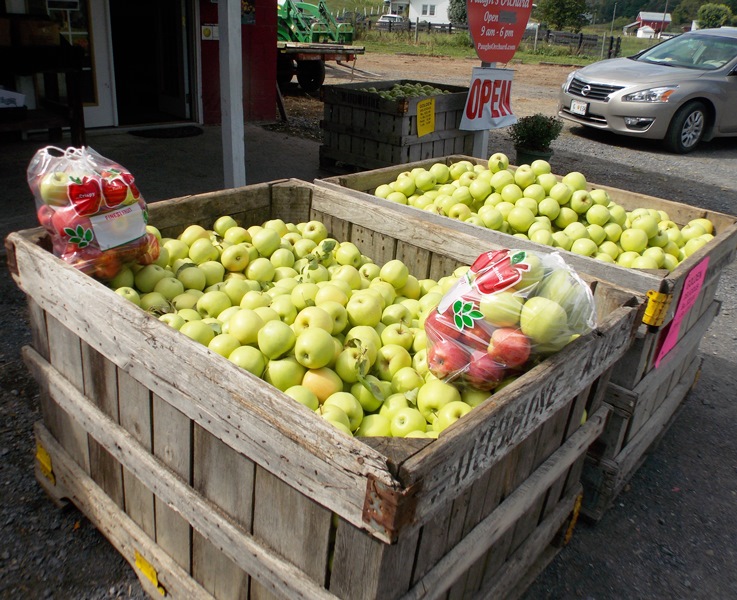
There's nothing like a big red apple sign to entice travelers to stop at a roadside stand in the fall for apples and mums. That's exactly what happened as my sister and I traveled the back roads of Shenandoah County this week, meandering where the wind took us and making discoveries along the way.... (Photos, read more here)
Wednesday, April 16, 2014
Wool Days at Frontier Culture Museum - April 16-19, 2014


Spring in Virginia's Shenandoah Valley means Wool Days at the Frontier Culture Museum in Staunton. The museum will shear sheep using traditional hand shears at 11:00 and
2:00 at either the English farm yard or at the 1850 American farm barn
yard. There is a good chance we will shear a third sheep at 10:00 most
days.
Visitors will have the opportunity to try many activities during Wool Days. Perhaps try your hand at:
* Weaving on the Irish FarmIt's sunny with comfortably cool temps in the 50s and 60s this week ... come on out and join costumed interpreters as they relive life as it was in earlier days of America.
* Card and spin wool on the 1820s American Farm
* Help sort and scour wool at the English Farm
* Process flax on the German Farm
* Touch flax, wool, and sheep
Saturday, April 12, 2014
Today & tomorrow: Waynesboro Fly Fishing and Wine Festival

Waynesboro will host the 14th Annual Virginia Fly Fishing Festival today and tomorrow. The festivities will take place in Constitution Park located on the banks of the South River with vendors, workshops, and a beautiful walkway for visitors.
The weekend weather is expected to be perfect -- sunny with temps in around 70 today and 80 on Sunday. Check out the website for the entire lineup of activities. Come play in the Valley!
Saturday, April 05, 2014
It's spring in Roanoke

I found spring this week, and it was in Roanoke. The flowering trees and forsythia haven't begun to bloom in my corner of Augusta County -- just jonquils and daffodils -- but in Roanoke it was a flourish of color and green grass.

Azaleas were in full bloom at this house off Plantation Road.

We had driven to Roanoke Friday to join political friends and Ed Gillespie for lunch and I was surprised as we entered the Roanoke Valley with all the colors of spring.


Spring is finding its way to western Virginia....
April 4, 2014
Tuesday, April 01, 2014
Road trip! Warm spring day in western Virginia

It was a beautiful spring morning when a friend and I headed south from Staunton to Lexington and then turned west on I-64 heading toward the Allegheny Mountains of western Virginia. If you've never driven this stretch of interstate, you've missed a beautiful part of Virginia and West Virginia.

This is the on-ramp for I-64 west of Lexington. Look at the scenery ... mountains, trees, blue sky.

First stop was Clifton Forge snuggled along the mountain bases.


There's a Tea Room in Clifton Forge!


And then out the western side of Clifton Forge back onto the interstate to nearby Covington.

The Chocolate Festival is this Saturday at the Armory in Clifton Forge. Sweet tooth mandatory....

Covington is a combination of small and large homes ...

... the railroad ...

... and a quaint downtown.


They have a new Visitor Center that also houses the Alleghany Highlands Chamber of Commerce.

By afternoon temperatures had reached 70 degrees as we lunched in Covington, then back on the road toward Lexington ...

... and the familiar sights of that area.

The Blue Ridge Mountains were ahead of us as we traveled east on I-64 and then north on I-81 before turning east on I-64 at Staunton to drive up and over to the eastern side of Afton Mountain before heading back home to Staunton.

Afton Mountain and Waynesboro in the Shenandoah Valley below. This part of Virginia touches hearts and souls ... it's a wonderful place to call home.
Photos by Lynn R. Mitchell
April 1, 2014
Wednesday, March 26, 2014
Photos: Early spring snowstorm in Shenandoah Valley ... how did mountain settlers handle winter?

Tuesday was a snow day in the Shenandoah Valley. White flakes began falling at daybreak and continued until dark, piling up accumulations that were a little higher than expected with anywhere from 4 to 7 inches and more. Friends who live in the shadow of Shenandoah National Park in the northeastern part of Augusta County reported receiving more than 7 inches.

SWAC Husband had shoveled a path to the bird feeder to keep our feathered friends fed and happy during the storm but a late afternoon micro-burst of big, fluffy snowflakes quickly covered any cleared areas and added up to 2 additional inches to the previous 3.5 inches.

In almost whiteout conditions, the late-day dumping after 12 hours of continuous snow gave the illusion of watching from inside a vigorously-shaken snow globe. It was beautiful -- big, fat flakes of white obscuring the mountain ridges in a kind of defiance as if it was winter's last hurrah. One can almost imagine Mother Nature with her flower-gilded broom sweeping the icy old man out the door with his blast of cold and swirling snow even as she opened a window to allow warm breezes to sweep in so that a greening can begin for winter-weary Virginians.


For a last hurrah, however, it was a beautiful winter wonderland with snow-flocked evergreens and ice-edged ponds.

The Appalachian Mountains can normally be seen in the background but the storm obliterated long-distance views of the surrounding ridges.

With the mountains obscured in the background, I often think about the mountain pioneers who settled western Virginia and how difficult winter weather must have been for them. With no forecasters to give a heads-up of incoming storms, what were the signs they looked for to know they must prepare for wintry precipitation? How long were they isolated during the long winter months, cut off from neighbors and towns by impassable routes that were not plowed and cleared immediately after (and often during) storms? How cold was it in cabins heated by fireplaces and wood stoves that worked overtime to push back at the howling winter winds and frigid temperatures that crept through uninsulated walls and floors? They were certainly hardy individuals who endured those difficult conditions while living on stored-up supplies and firewood from months of preparation for the cold.

My grandfather was born in a cabin on "The Knob" in Grayson County, Virginia ... a three-room rough structure typical of thousands of others in the mountains. It had two rooms downstairs -- kitchen lean-to and main room -- and a big room upstairs. The walls were chinked with clay and the floor was several feet above the ground with stones around the foundation. A stone fireplace in the main room was the central heat in this little home perched on a mountain. My grandfather's brother, my Uncle Isom Osborne, married and raised his family in the shadow of "The Knob," but when he was first married, they lived with his parents on "The Knob" until settling in their own place. His wife was my Aunt Okie, and years after he died and Aunt Okie was up in age and when my son was an infant, I talked with Aunt Okie about that cabin.

We were all piled into my cousin's pickup truck as we had done since I was a kid only this time, instead of riding in the bed of the truck as I always did, I was seated in the cab with my cousin, Aunt Okie in the middle, and me with a baby on my lap. I was full of questions about life back then, and she told of having an infant during winter in the cabin. I couldn't imagine having to go about daily activities with my baby in winter in a drafty, freezing-cold house with only a fireplace to heat it and water hauled from the spring tucked just under the hill.
"How in the world did you survive?" I asked her as we jostled up the familiar rutted mountain road that had been part of the isolation of "The Knob."
She just smiled in a patient kind of way and matter-of-factly replied, "We just did. We managed." No complaints, no blaming anyone else, no excuses. They managed, they survived, they raised their five children, and all five live not far from the shadow of "The Knob."

When my children were young, one of our favorite books to read out loud was Laura Ingalls Wilder's The Long Winter. When cold winter weather limited outdoor time, we often sat near the wood stove as my kids listened while I read about Laura and her family living through the historic winter of 1880-81 that was full of blizzards and hardships. Without a national weather bureau, Pa looked for weather signs in nature and that summer he noticed that the walls of a nearby muskrat den were the thickest he had ever seen. He took it as a sign that winter was going to be especially harsh.
A Native American also warned that there would be seven months of blizzards in South Dakota that winter and, sure enough, the first one hit in October and they continued through April. Whiteouts kept children from attending school, supplies dwindled and became scarce, and the Ingalls family ended up burning twisted straw to heat their house after they ran out of wood. Feet and feet of snow piled up on the railroad tracks and blocked trains that carried food and other provisions and, by the time spring finally arrived, some settlers were nearly starved.
We never tired of the story because it was fact. Real people faced real hardship and survived.
This February 2014 newspaper article from the Star Tribune remembers the winter of 1880-81 as it notes, "Forty degrees below? Storm after storm? Months without respite from the cold? Sounds familiar. But at least you could get to the grocery store."
This February 2014 newspaper article from the Star Tribune remembers the winter of 1880-81 as it notes, "Forty degrees below? Storm after storm? Months without respite from the cold? Sounds familiar. But at least you could get to the grocery store."

Flocked evergreens, farm gates, and stark winter woods. The storm offered one last chance to listen to the quiet, muted by a
layer of insulation that won't be back until next winter. Although it's
not out of the question to see snow in April (and some even remember it
in May), the jet stream is shifting into a more seasonal spring pattern
that will bring warmer temperatures to the Shenandoah Valley and
Virginia. Since I couldn't stand to just sit inside and watch, I took the opportunity to get outdoors and capture the rural beauty of my neighbors' fields and woods.

The horses were inside out of the weather. It reminded me of Tater and Max in warmer weather as they waited to be fed by SWAC Daughter as seen here in April of 2008, and I couldn't help but chuckle as I remembered Tater's encounter with a herd of guinea hens in her field later that year ("Invasion!!").

This is the time of year when it's obvious how many evergreens we have in the Valley.


The last tracks of winter....?
Photos by Lynn R. Mitchell
March 25, 2014
Subscribe to:
Posts (Atom)